
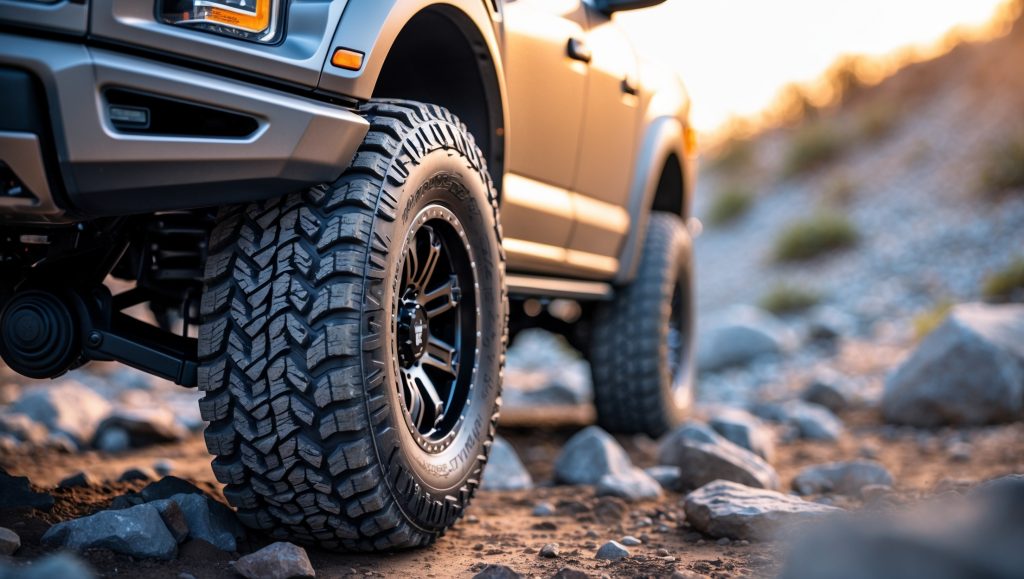
Overview
The BFGoodrich All-Terrain T/A KO2 is an all-terrain (AT) tyre engineered for drivers who need dependable performance both on and off the pavement. Targeted primarily at owners of pickup trucks, SUVs, and 4×4 vehicles, the KO2 is a consistent favorite among adventure seekers, overlanders, ranchers, and anyone who regularly faces dirt roads, gravel, mud, or snow—but still spends plenty of time on the highway. Designed as an all-season tyre, it blends off-road toughness with solid everyday manners, making it a go-to choice for those who want one set of tyres to handle nearly any condition.
Key Specs
| Type | All-terrain (AT), All-season |
| Available sizes range | 15″ to 22″ wheel diameters, widths from 215 to 375 mm |
| Speed rating examples | R (106 mph), S (112 mph), T (118 mph) |
| Load index examples | 104 (1984 lbs), 121 (3197 lbs), 126 (3748 lbs) |
| Tread pattern | Aggressive, interlocking tread blocks, serrated shoulder design |
| Technology highlights | CoreGard sidewall tech, stone ejectors, 3-Peak Mountain Snowflake (3PMSF) certified, twin steel belts |
Performance: Dry
On dry pavement, the KO2 delivers a stable and predictable feel. While not as sharp as a dedicated highway or sport truck tyre, its steering response is surprisingly direct for an AT. The reinforced sidewalls and interlocking tread blocks provide consistent handling and confidence at highway speeds—even when towing or hauling. Braking distances are competitive among other all-terrain tyres, and the wide footprint offers good grip when cornering. That said, expect a touch more squirm and softer turn-in than with road-focused tyres, especially in the larger sizes. Overall, for daily driving and the occasional spirited trip down a winding road, the KO2 holds its own.
Performance: Wet
Wet traction is a strong suit of the All-Terrain T/A KO2. The multi-angled sipes and open tread channels efficiently evacuate water, reducing hydroplaning risk noticeably compared to older AT models. Braking in rain remains predictable, with only moderate increases in stopping distance versus dry conditions. Lateral grip is reassuring in the wet, giving drivers confidence on slick highways or muddy construction sites. However, like most aggressive AT tyres, the KO2 can become slightly noisy and feel less planted during sudden, extreme maneuvers on soaked pavement—a tradeoff for its off-road prowess.
Performance: Snow & Ice
The KO2 is 3PMSF (Three-Peak Mountain Snowflake) certified, meaning it has passed specific industry tests for severe snow service. In real-world use, this translates to reliable traction in light to moderate snow, both on-road and off. The deep tread and biting edges grip packed snow well, and the tyre is noticeably more sure-footed than typical all-season or highway terrain tyres. On ice, performance is average—like most ATs without studs, it can’t match a true winter tyre, but it’s manageable with prudent driving. For drivers in regions where snow is a regular concern but not extreme, the KO2 offers genuine year-round usability.
Comfort & Noise
For an all-terrain tyre, the KO2 strikes a respectable balance between ride comfort and ruggedness. On smooth roads, it’s composed, with only a bit more road feel than a highway tyre. Over rough pavement and gravel, the robust construction helps absorb impacts, though the ride can feel firmer, especially at higher pressures or with heavier load ratings. Noise levels are moderate: the tread pattern produces a distinct hum at highway speeds, but it’s less intrusive than many rival ATs. For most drivers, the noise is noticeable but not fatiguing—even on longer trips.
Durability & Economy
The KO2’s reputation for toughness is well deserved. Reinforced sidewalls and a cut-resistant tread compound mean it shrugs off sharp rocks and debris that can sideline lesser tyres. Treadwear is excellent for the category—many users report 40,000–50,000 miles, even with regular off-road use. The KO2’s UTQG rating (Uniform Tire Quality Grading) is typically 500 A B, which is strong for an AT tyre. Rolling resistance is higher than a street tyre, slightly impacting fuel economy, but in real-world mixed driving, the penalty is minor. For fleets or high-mileage users, the longevity and damage resistance help offset the upfront cost.
Sizes & Alternatives
The BFGoodrich KO2 is available in an extensive range of sizes, covering everything from mid-size SUVs to full-size pickups and off-road rigs. Two popular sizes include:
- LT265/70 R17 (commonly fitted to Ford F-150, Toyota Tacoma, Chevrolet Silverado)
- LT285/75 R16 (popular for Jeep Wrangler, Toyota 4Runner, older Land Cruisers)
Notable competitors in the US market:
- Goodyear Wrangler All-Terrain Adventure with Kevlar
- Falken Wildpeak A/T3W
- General Grabber A/TX
- Toyo Open Country A/T III
- Cooper Discoverer AT3 4S
Pros & Cons
Pros
- Excellent off-road traction across dirt, gravel, mud, and snow
- Durable construction and strong sidewall protection
- Impressive treadwear for an all-terrain tyre
- 3PMSF rating for true all-season versatility
- Wide size range fits nearly all popular trucks and SUVs
Cons
- Noticeable tread noise at highway speeds
- Ride can be firmer than highway terrain tyres
- Higher rolling resistance impacts fuel economy slightly
- Ice traction still limited compared to dedicated winter tyres
- Premium pricing versus some competitors
Verdict
The BFGoodrich All-Terrain T/A KO2 is a benchmark for drivers who demand a tyre that excels on rugged trails but doesn’t compromise daily usability. Its combination of toughness, off-road grip, and on-road composure makes it a smart investment for truck and SUV owners who split their driving between the city and the backcountry. While there’s a bit more noise and a firmer ride compared to street tyres, these are minor tradeoffs for the versatility and peace of mind the KO2 delivers. Its long tread life and damage resistance make it appealing for fleets, overlanders, and anyone who can’t afford downtime. If you’re looking for one tyre to handle everything from the weekday commute to weekend adventures, the KO2 remains one of the US market’s most trusted all-terrain choices. Just be mindful of its limitations on hard-packed ice, and expect a slight drop in fuel economy. For most, the KO2’s strengths far outweigh its compromises.
I see the KO2 is designed for everything from dirt and mud to highways. How does it handle long road trips with a full load—does road noise or comfort become an issue?
The KO2 performs well on long road trips, even with a full load. Road noise is generally minimal for an all-terrain tire, and comfort levels are good, though you may notice a slightly firmer ride compared to highway-specific tires. Most drivers find them perfectly suitable for extended highway use.
For someone who occasionally hauls heavy loads, does the reinforced sidewall make a noticeable difference, or should I be looking at a different type of tire?
The reinforced sidewall on the KO2 does make a noticeable difference when hauling heavy loads, offering better protection against punctures and improved stability. For occasional heavy hauling, the KO2 should handle your needs well. If you frequently haul very heavy loads, you might want to consider LT (Light Truck) tires with higher load ratings specifically designed for heavier-duty use.
How does the road noise of the KO2 compare to other all-terrain tyres when driving on the highway with an SUV? I’m worried about things being too loud for the kids.
The KO2 is known for being relatively quiet compared to many other all-terrain tires, especially on highways. While there is a bit more road noise than standard highway tires, most users find it very manageable and not disruptive inside an SUV, even with kids onboard.
Is there a noticeable difference in wet traction performance between the smaller and larger KO2 sizes?
Wet traction performance with the KO2 is generally consistent across different sizes, but larger sizes may have a slightly wider contact patch, which can help with grip. However, the tread compound and pattern remain the same, so any difference is usually minor and not very noticeable in typical driving conditions.
For someone who mainly uses their truck for towing on weekends and normal driving during the week, is the load index more important than the tread pattern when choosing the right KO2 size?
For your usage—towing on weekends and regular driving during the week—the load index is definitely crucial. It ensures the tyres can safely handle the weight of your truck and any loads you tow. While the tread pattern matters for traction and performance, prioritizing the correct load index should come first for safety and durability.
Does the KO2’s 3-Peak Mountain Snowflake certification mean it performs as well in deep winter conditions as a dedicated snow tire, or are there certain limitations to be aware of?
The KO2’s 3-Peak Mountain Snowflake certification means it meets minimum traction standards for severe snow, making it better in winter than regular all-season tires. However, it doesn’t perform quite as well as a dedicated snow tire in deep winter conditions, especially on ice or packed snow. For extreme winter driving, a specialized winter tire is still the best choice.
With KO2s having a 3-Peak Mountain Snowflake rating, how do they actually perform in real snow compared to dedicated winter tires, especially in places like Colorado?
BFGoodrich KO2s handle light to moderate snow well, thanks to their 3-Peak Mountain Snowflake rating and aggressive tread. However, in Colorado’s harsh winter conditions, dedicated winter tires still offer superior grip and braking on ice and deep snow. KO2s are a solid all-terrain option but won’t match the specialized performance of true winter tires.
Can anyone share their experience with how quickly these KO2s wear when mostly used for highway driving versus a mix of off-road use? I’m wondering about the long-term value for a daily driver.
From user feedback, KO2s tend to wear quite slowly when used mostly on highways, often lasting 40,000–50,000 miles or more. With regular off-road use, tread life may shorten, but they still hold up well compared to many all-terrain options. For daily drivers, they’re considered a solid long-term value, especially if you rotate them regularly and keep them properly inflated.
With the KO2’s wide range of available sizes, do you notice any significant ride comfort or noise differences between smaller 15-inch and larger 22-inch options on daily drives?
Yes, there are some noticeable differences. Smaller 15-inch KO2s, usually with taller sidewalls, generally offer a smoother, more cushioned ride and tend to absorb bumps better. Larger 22-inch options often have shorter sidewalls, which can make the ride feel firmer and may transmit more road noise and bumps. Daily drivers typically find smaller sizes more comfortable.
I see the KO2 has 3PMSF certification—does it actually work well in deep snow, or just light winter conditions? Hoping to avoid buying a second set of dedicated snow tires.
The KO2’s 3PMSF rating means it performs better in winter than regular all-terrains, handling light to moderate snow well. However, in deep snow or icy conditions, it won’t match the grip and safety of dedicated winter tires. For frequent deep snow, a true winter tire is still the safer choice.
Does the CoreGard sidewall technology noticeably reduce the risk of punctures or sidewall damage in rocky conditions based on your testing?
Based on our testing, CoreGard sidewall technology does provide a noticeable improvement in resistance to punctures and sidewall damage, especially in rocky terrain. The reinforced sidewalls helped the KO2 withstand impacts and abrasions that might have damaged standard all-terrain tires.
For a budget-conscious buyer replacing a full set on a half-ton pickup, do you know if the KO2 tends to wear quickly when mostly used on dry highways?
The KO2 is known for its durability and tends to wear slowly, even with mostly highway use on dry roads. Many users report getting good mileage before needing a replacement. While it’s not the cheapest all-terrain option, its longer tread life often offsets the initial cost for budget-minded drivers.
With the KO2’s aggressive tread and stone ejectors, have users noticed a big increase in road noise or vibration on long highway drives?
Most users report that the KO2’s aggressive tread and stone ejectors do add some road noise compared to standard highway tires, especially at higher speeds. However, the increase is generally mild and not considered uncomfortable for long highway drives. Vibration is minimal for properly balanced tires. Many drivers find the trade-off worthwhile for the added off-road capability.
For someone who mainly drives on highways but occasionally needs off-road capability, is it worth paying more for the KO2 versus a less aggressive all-season tire?
If your driving is mostly highway with only occasional light off-road use, a less aggressive all-season tire will usually give you a quieter ride, better fuel economy, and lower cost. The KO2 excels in tougher off-road conditions, so it’s worth the premium mainly if you expect to encounter rougher terrain regularly or need extra durability.
I like the aggressive tread, but do these tires get noticeably loud at highway speeds after some miles? I do a lot of road trips and want to keep cabin noise reasonable.
The KO2s are a bit louder than standard highway tires due to their aggressive tread, but most users find the noise level quite reasonable, even after some miles. Road noise can increase slightly as they wear, but it’s not usually excessive or disruptive for road trips.
Is there a noticeable difference in tread life or road noise between the 15-inch and 22-inch KO2 sizes when used mostly on pavement?
When used mostly on pavement, tread life for the KO2 tends to be similar across 15-inch and 22-inch sizes, assuming proper inflation and rotation. However, larger 22-inch KO2s may produce slightly more road noise and a firmer ride due to their lower sidewalls. Actual differences are minor for everyday use, but you might notice a bit more hum from the 22-inch tires.
I see the KO2 has CoreGard sidewall tech and stone ejectors. Have you noticed any real-world benefits from these features when driving through rocky trails or gravel roads?
Absolutely, CoreGard sidewall technology provides noticeable extra protection against punctures and splits on rocky trails, helping the tire withstand sharp rocks better than standard options. The stone ejectors really help keep gravel from getting wedged in the tread, so you get better traction and less risk of stone drilling. Overall, both features make a positive difference in rough, rocky conditions.
I saw that the KO2 has the 3-Peak Mountain Snowflake certification. Does that mean it’s truly good enough for winter driving, or would I still need dedicated snow tires for trips up north?
The KO2’s 3-Peak Mountain Snowflake certification means it meets specific standards for winter traction, making it a solid choice for light to moderate winter conditions. However, if you expect frequent icy roads or deep snow on your trips up north, dedicated snow tires will provide superior grip and safety compared to all-terrains like the KO2.
Do the stone ejectors and CoreGard sidewalls make a big difference in preventing punctures on rocky trails? I’m a bit worried about damaging new tires off-road.
The stone ejectors and CoreGard sidewalls are designed specifically to help protect against punctures on rocky trails. The stone ejectors push out debris that could otherwise get stuck and cause damage, while the reinforced CoreGard sidewalls add extra resistance to cuts and bruises. These features do make a noticeable difference, offering more durability and peace of mind when driving off-road.
For someone who mainly commutes on highways but occasionally tows, would the KO2’s slightly softer turn-in be a concern compared to a highway-focused tyre?
If your driving is mostly highway commuting with only occasional towing, the KO2’s slightly softer turn-in compared to highway-focused tyres likely won’t be a major concern. You’ll still get reliable handling and good stability, but if you prioritize crisp steering response, a highway-terrain tyre might feel more precise.
You noted a bit of squirm and softer turn-in, especially with larger sizes. For mostly highway use but occasional off-roading, would the KO2 still be preferable over a highway terrain tire?
For mostly highway driving with just occasional off-roading, a highway terrain (HT) tire usually provides better on-road comfort and more precise handling than the KO2. However, if you expect rougher trails or more challenging off-road conditions at times, the KO2’s extra durability and traction could be worth the slight compromise in highway feel.
With the load index options you mentioned, would the KO2 be suitable for towing a medium-sized camper regularly, or should I look for something designed specifically for towing?
The KO2 comes in load ranges suitable for towing, especially in E (10-ply) ratings. If your camper falls within the tyre’s load capacity, the KO2 should perform well for regular towing. For extra peace of mind or if your camper is on the heavier side, tyres specifically designed for heavy towing may offer greater stability and heat resistance.
I noticed the KO2 is 3-Peak Mountain Snowflake certified. Have you found its winter performance to be on par with dedicated snow tires, or should I still consider switching for harsh Northeast winters?
The KO2 performs impressively in winter thanks to its 3-Peak Mountain Snowflake rating, making it suitable for moderate snow and cold conditions. However, for harsh Northeast winters with frequent ice and deep snow, dedicated snow tires still offer better traction and stopping power. If you drive often in extreme winter weather, switching to true winter tires is recommended for maximum safety.
With load indexes like 121 and 126, would these hold up well for frequent towing or hauling in a ¾-ton pickup, or should I be looking at a designated LT tire instead?
The KO2 with load indexes like 121 and 126 is actually an LT (Light Truck) tire, designed for heavier loads and towing, which fits the needs of most ¾-ton pickups. As long as the load index meets or exceeds your truck’s requirements, these should be suitable for frequent towing or hauling.
Are there any significant differences in tread life or performance between the smaller 15-inch and larger 22-inch KO2 sizes?
The KO2 uses the same tread compound and design across all sizes, so tread life and core performance are very similar whether you choose 15-inch or 22-inch versions. However, larger sizes can sometimes ride firmer and may weigh more, which could slightly affect acceleration, braking, and fuel economy. For everyday use, differences in tread wear or traction are usually minimal.
With such a wide range of available sizes, how should I decide which KO2 spec is best for occasional off-roading but mostly city driving on a half-ton pickup?
For mostly city driving with some occasional off-roading, select a KO2 size that matches your truck’s OEM (factory) tire specifications. This ensures optimal ride comfort, handling, and speedometer accuracy. Avoid upsizing too much, as larger tires can affect fuel economy and steering. Load and speed ratings should meet or exceed your truck’s requirements.
How does the KO2 handle stone retention and potential punctures on rocky trails compared to similar AT tires from other brands? Any tips to avoid damage during worksite use?
The KO2 features a tough sidewall and a specially designed tread pattern that helps eject stones, minimizing stone retention compared to many other all-terrain tires. Its thick rubber compound also boosts puncture resistance. To reduce damage on worksites, keep tires properly inflated, avoid overloading, and regularly inspect for embedded debris or sharp objects.
Does the KO2’s 3-Peak Mountain Snowflake rating mean it performs well in severe winter conditions, or would dedicated snow tires still be necessary during heavy snowfalls?
The KO2’s 3-Peak Mountain Snowflake rating means it meets the minimum standards for severe snow performance and is a solid choice for occasional winter driving. However, for frequent or intense snow and ice conditions, dedicated winter tires will still offer superior grip and safety.
Does the KO2’s aggressive tread pattern make a noticeable difference for occasional off-roading, or would a more highway-oriented tire handle light trails just as well for a beginner?
The KO2’s aggressive tread pattern does provide better traction and durability on loose surfaces like dirt, gravel, or mud, even during occasional off-roading. While a highway-oriented tire can handle light trails, the KO2 will give you extra confidence and grip if your trails get more challenging or muddy, making it a solid choice even for beginners.
Does the KO2’s 3-Peak Mountain Snowflake rating mean it’s actually suitable for deep winter and ice, or would I still need dedicated snow tyres for harsh conditions?
The KO2’s 3-Peak Mountain Snowflake rating means it performs better in winter than standard all-season tyres, especially in snow. However, for harsh winter conditions with lots of ice and deep snow, dedicated winter tyres will provide much better traction and safety. The KO2 is a good compromise, but not a full substitute for true snow tyres in extreme cold.
Are there any noticeable differences in wet braking or hydroplaning resistance between the different available widths of the KO2, such as 215 mm versus 375 mm?
Yes, there can be noticeable differences. Wider KO2 tyres, like 375 mm, tend to have a higher risk of hydroplaning compared to narrower ones such as 215 mm, especially in heavy rain. Narrower tyres usually cut through water more easily, offering better wet braking and hydroplaning resistance. However, actual results also depend on vehicle weight, speed, and tread depth.
My SUV usually hauls heavy loads for weekend activities. Would the KO2’s load index options be suitable for towing a small camper as well?
The BFGoodrich KO2 offers a range of load index options, many of which are designed with heavier loads and towing in mind. For hauling a small camper with your SUV, you should choose a KO2 size and load rating that matches or exceeds your vehicle’s tow and payload requirements. Double-check your SUV’s specifications and select a KO2 with an appropriate load index for safe towing.
I’m curious about longevity—what kind of real-world mileage have US truck owners seen before needing a replacement set of KO2s?
Many US truck owners report getting between 40,000 and 60,000 miles from their BFGoodrich KO2s, with some even seeing up to 70,000 miles with proper care. Actual mileage depends on factors like driving habits, regular rotations, correct inflation, and road conditions.
Can you give an idea about tread life for these KO2s with regular highway use? I rack up a lot of miles commuting and want to know if the durability is worth the price.
The KO2s are known for their long tread life, especially compared to other all-terrain tires. On regular highway use, many drivers report getting around 50,000 to 60,000 miles before needing replacements. Their tough compound and design help them wear slowly, making them a solid choice for high-mileage commuters.
If I rotate my tires regularly, what kind of mileage can I realistically expect from a set of KO2s before they need replacing, especially if I mix highway and off-road driving?
With regular rotations and a mix of highway and off-road use, you can typically expect around 40,000 to 50,000 miles from a set of KO2s before they need replacing. Actual mileage can vary based on driving habits, terrain, and maintenance, but many users report falling within this range.
Does the KO2’s 3-Peak Mountain Snowflake certification mean it works as well as a true winter tire on icy roads or is it still a compromise for northern states?
The KO2’s 3-Peak Mountain Snowflake certification means it performs better in winter conditions than regular all-season tires, especially on snow. However, it doesn’t match the grip and cold-weather performance of a dedicated winter tire, especially on icy roads. For northern states with harsh winters, a true winter tire is still the best choice for maximum safety.
For someone who mainly drives on highways but occasionally needs to tackle muddy roads, is there a noticeable ride comfort difference with these versus a standard all-season tire?
You may notice a firmer ride with the KO2 compared to standard all-season tires, especially on highways. The KO2 is built for off-road durability, so it’s a bit stiffer and can be slightly noisier. However, it offers much better traction on muddy roads when needed. If your main concern is highway comfort, an all-season tire will feel smoother, but the KO2 balances some off-road ability with reasonable everyday comfort.
You mention the KO2 is 3-Peak Mountain Snowflake certified. Does that mean it performs well in deep winter snow for northern states, or is it more suited to lighter snow conditions?
The KO2’s 3-Peak Mountain Snowflake certification means it meets specific standards for traction in severe winter conditions, so it does perform better than standard all-season tires in snow. However, while it handles moderate to heavy snow well, for deep winter snow and frequent icy conditions in northern states, a dedicated winter tire will still outperform it.
Does the KO2’s aggressive tread pattern make much noise on the highway, or is it still pretty quiet for daily driving?
The KO2’s aggressive tread does create a bit more noise compared to regular highway tires, but most users find it pretty reasonable for daily driving. It’s not silent, but the noise level is manageable and much quieter than traditional mud-terrain tires. For most people, it won’t be bothersome on highways.
With the KO2 available in sizes all the way up to 22 inches, is there a noticeable change in ride comfort or noise between, say, 17 and 20 inch versions? I’m trying to pick the best size for my F-150.
Choosing between 17 and 20 inch KO2s can impact your ride. Generally, larger wheels (20 inch) mean a smaller sidewall, which can result in a firmer ride and slightly more road noise compared to 17 inch versions. The 17 inch size usually offers more cushioning and a smoother ride, especially on rough surfaces, making it popular for comfort-focused truck owners.
How does the KO2 handle in deep snow compared to a dedicated winter tire, especially since it’s 3-peak mountain snowflake certified?
The KO2 performs well in deep snow for an all-terrain tire, thanks to its aggressive tread and 3-peak mountain snowflake certification. However, dedicated winter tires typically offer better traction, grip, and braking in severe winter conditions due to their softer rubber compounds and specialized patterns. The KO2 is a strong all-rounder but not a full substitute for a true winter tire in extreme snow.
Does the CoreGard sidewall tech help prevent punctures from rocky trails, and how does it actually work in real-world off-road situations?
The CoreGard sidewall technology does help prevent punctures when tackling rocky trails. It uses thicker, tougher rubber in the sidewalls, making them more resistant to splits and bruising caused by sharp rocks. In real-world off-roading, this means the tyres can better withstand impacts and rough terrain, reducing the risk of sidewall damage.
Does the aggressive tread pattern of the KO2 have any impact on long-term maintenance costs, like balancing or alignment, compared to less rugged all-season tires?
The KO2’s aggressive tread can sometimes lead to slightly more frequent balancing or alignment checks, especially if you drive off-road often. While it doesn’t drastically increase maintenance costs, you may notice a bit more irregular wear compared to smoother all-season tires, so keeping up with rotations and inspections is important for best results.
I’m curious how the KO2s handle when they’re loaded near their max load index, especially for towing—does their grip or ride quality change a lot compared to everyday driving?
When the KO2s are loaded near their max load index, especially during towing, you might notice a slightly firmer ride since the tyres are supporting more weight and may need increased air pressure. Grip remains reliable under load, but handling can feel less responsive compared to light, everyday driving. It’s important to keep the tyres at the recommended pressure for heavy loads to maintain safety and performance.
I noticed there’s a big range of sizes and load indexes. For towing a camper with my half-ton truck, which load index should I be looking at in the KO2 lineup?
For towing with a half-ton truck, it’s best to look for KO2 tires with a load index of at least 113 or higher, which usually means a load range C or D. This ensures the tires can safely handle the added weight of your camper and cargo. Double-check your truck’s manual for recommended specs before choosing a size.
How do the KO2’s winter capabilities with the 3-Peak Mountain Snowflake certification compare to dedicated winter tires, especially on icy roads?
The KO2’s 3-Peak Mountain Snowflake rating means it outperforms standard all-terrains in winter conditions, handling snow quite well. However, compared to dedicated winter tires, the KO2 won’t provide the same level of traction and braking performance on icy roads. Winter tires use specialized rubber that stays flexible in extreme cold and often have tread designed specifically for ice and packed snow, offering superior grip in those conditions.
Are there any budget-friendly alternatives to the KO2 that still offer similar off-road performance and technology features like the CoreGard sidewall or stone ejectors?
If you’re looking for budget-friendly alternatives to the KO2, consider tires like the Falken Wildpeak A/T3W or General Grabber A/TX. Both offer strong off-road traction, durable sidewalls, and features similar to stone ejectors, though their sidewall tech may not fully match KO2’s CoreGard. They still provide excellent value and dependable all-terrain performance.
For someone mostly driving on pavement but taking occasional camping trips on dirt or gravel, would you recommend going with narrower or wider KO2 sizes?
For mostly paved driving with occasional dirt or gravel trips, a narrower KO2 size is usually a better choice. Narrower tires tend to provide better traction on loose surfaces and are generally quieter and more fuel-efficient on pavement, while still offering plenty of capability for camping trips.
Can you clarify if the 3-Peak Mountain Snowflake rating means these are truly suitable for winter driving in areas that get a lot of ice and snow?
The 3-Peak Mountain Snowflake rating certifies that the KO2 meets industry standards for severe snow performance. This means it’s more capable in snow than regular all-season tires. However, while the KO2 performs well in snow, it may not grip icy roads as effectively as dedicated winter tires, so consider your area’s conditions and driving needs.
You noted that the KO2 provides a bit more squirm and softer turn-in than road-focused tires. Is this difference mostly noticeable in higher speed cornering, or does it affect lower-speed daily driving as well?
The softer turn-in and slight squirm of the KO2 are most noticeable during higher speed cornering or quick steering maneuvers. For typical lower-speed daily driving, these differences are much less pronounced, and the tire generally feels stable and comfortable in regular urban or suburban use.
For winter use, does the 3-Peak Mountain Snowflake rating on the KO2s make a noticeable difference in real-world snowy or icy conditions versus standard all-terrain tires?
The 3-Peak Mountain Snowflake (3PMSF) rating on the KO2s means they meet higher standards for winter traction compared to regular all-terrain tires. In real-world snowy or icy conditions, you’ll notice improved grip and braking performance over non-3PMSF all-terrains, making them a safer choice for winter driving, though not quite as effective as a dedicated winter tire.
For someone mostly driving on highways but wanting to do some light off-roading on weekends, does the KO2’s more aggressive tread pattern affect road noise or ride comfort compared to standard highway tires?
The KO2’s aggressive tread pattern does generate a bit more road noise and can feel slightly firmer than standard highway tires, especially on smooth pavement. However, most drivers find the difference minor, and the KO2 still offers good comfort and quietness for daily highway use, while giving you extra capability for weekend off-roading.
Given the aggressive tread pattern and stone ejectors, have you run into any issues with road noise or vibrations at highway speeds after a few thousand miles?
According to the review, while the KO2’s aggressive tread and stone ejectors do increase traction off-road, most users report only a mild increase in road noise at highway speeds. Vibrations typically remain minimal, even after several thousand miles, as long as the tyres are balanced and rotated regularly.
Do these tyres affect fuel economy much because of their aggressive tread pattern and reinforced sidewalls?
Yes, the BFGoodrich All-Terrain T/A KO2 tyres can have a slight impact on fuel economy. Their aggressive tread pattern and reinforced sidewalls add weight and rolling resistance compared to standard road tyres. While the difference isn’t huge, you may notice a small reduction in miles per gallon, especially if you mostly drive on highways.
Given the load index options, would the KO2 be suitable for towing a medium-sized trailer, or should I look for something with a higher rating?
The KO2 comes in various load index options, and some are definitely suitable for towing a medium-sized trailer, especially in the LT (Light Truck) range. Just make sure to select a version with a load index that meets or exceeds your trailer and vehicle requirements. If your total weight is on the higher end, you might want to consider tyres with an even greater load rating for extra safety margin.
Does the road noise from the KO2s get noticeably louder on the highway compared to typical all-season tires, especially in the larger sizes?
Yes, the KO2s are generally a bit louder on the highway than typical all-season tires, especially in larger sizes. While the noise isn’t extreme, you may notice a steady hum at higher speeds. The aggressive tread pattern provides off-road grip but does increase road noise compared to standard all-seasons.
Since the KO2 is 3-Peak Mountain Snowflake certified, would you recommend it for daily winter driving in northern states, or is a dedicated snow tire still a better choice?
The KO2 performs well in winter thanks to its 3-Peak Mountain Snowflake rating and offers reliable traction for most snowy conditions. However, for prolonged periods of icy, packed snow or extreme cold in northern states, a dedicated snow tire will still provide better grip and safety. If winters are particularly harsh where you drive, snow tires remain the top choice.
Can you talk about how the KO2s perform as all-season tires if we’re in a region with wet springs and hot summers—do they stay grippy or do they harden up over time?
The KO2s perform well as all-season tires, maintaining good grip in both wet spring conditions and hot summer weather. Their rubber compound is designed to resist hardening, so you should continue to get reliable traction even as the tires age. Regularly checking tire pressure and rotation will also help maintain their performance.
Is the KO2 a good choice for snowy winters in the Midwest, or would I be better off with a dedicated winter tire? I see it has the 3-peak mountain snowflake rating, but how does it actually perform in deep snow?
The KO2 handles snowy conditions better than many all-terrain tires, thanks to its 3-peak mountain snowflake rating and aggressive tread. However, in deep snow and extreme Midwest winters, a dedicated winter tire will still outperform it in traction and braking. The KO2 is a solid all-rounder, but for the harshest winter conditions, winter tires are the safer bet.
Do the stone ejectors in the tread actually help prevent picking up rocks and causing tire damage, or is that more of a marketing claim? I drive a lot of gravel roads and worry about punctures.
The stone ejectors in the KO2 tread are designed to push out small rocks and debris, which can help reduce the chance of stones getting lodged and causing punctures. While not foolproof, they do provide real benefits for frequent gravel road use by helping protect the tire from stone drilling and potential damage.
I see the KO2 comes in a lot of different sizes—are there major performance differences between the narrower and wider versions for SUVs mainly used on highways?
For SUVs mostly driven on highways, narrower KO2 tires often provide better fuel efficiency, less road noise, and improved traction in rain or snow. Wider versions typically offer more grip on loose surfaces but can feel less precise and may increase fuel consumption. For mostly highway use, a narrower size within your vehicle’s recommended range is usually a good choice.
With sizes ranging from 15 to 22 inches, do you notice any difference in handling or comfort between smaller and larger KO2 tyre sizes on daily drives?
Yes, there are some differences. Larger KO2 tyre sizes generally provide a smoother, more comfortable ride and may handle bumps better due to extra sidewall height. Smaller sizes can offer more responsive handling but might feel a bit firmer on rough roads. Your experience will also depend on your vehicle and driving habits.
The KO2 is 3PMSF certified for snow—does that mean I can skip dedicated winter tires if we only get light snow a few times a year?
The KO2’s 3PMSF certification means it performs better than regular all-seasons in snow, so for light, occasional snow it can work well. However, if you regularly encounter icy roads or heavier snow, dedicated winter tires still offer superior grip and safety.
I see the KO2 uses CoreGard sidewall tech and stone ejectors—how well do these features hold up when you’re running on sharp Ozark gravel trails for extended periods?
CoreGard sidewall tech in the KO2 is designed to resist splitting and bruising, which really helps on sharp, rocky trails like those in the Ozarks. The stone ejectors actively prevent small rocks from lodging in the tread, reducing the risk of punctures. Users report these features hold up well over extended use, although steady inspection for deep cuts or embedded debris is still recommended after tough runs.
How do the KO2s usually wear over time when used mostly on pavement, and is there a typical mileage where people start seeing performance drop-offs?
When mostly used on pavement, KO2s generally wear quite evenly and can last between 40,000 to 60,000 miles, depending on driving habits and maintenance. Many users notice a decrease in wet traction and road noise performance starting around 40,000 miles, although tread depth often remains usable beyond that point.
I see load indices up to 126 listed; is this tire suitable for regularly towing heavy trailers, or would a more specialized tire be recommended for max payloads?
The KO2 with a load index of 126 can handle substantial weight and is suitable for moderate towing and hauling. However, if you’ll be regularly towing at or near your vehicle’s maximum payload, a dedicated heavy-duty or commercial-grade tire designed specifically for maximum loads may offer better durability and safety.
With sizes running up to 22 inches and widths up to 375 mm, are there any fitment or rubbing issues on popular half-ton pickups like the F-150 or Silverado without lift kits?
Using the largest available KO2 sizes, especially up to 22 inches or 375 mm wide, will likely cause fitment or rubbing issues on stock F-150s or Silverados without a lift or fender modifications. For half-ton pickups without suspension changes, it’s best to stick to the manufacturer’s recommended size range to avoid potential clearance problems.
You mentioned a bit more squirm and softer turn-in with larger KO2 sizes. Does that become a real issue for anyone towing heavier loads, or is it only noticeable in aggressive driving?
For most towing situations, the extra squirm or softer turn-in with larger KO2 sizes isn’t a significant issue. It’s mainly noticeable during aggressive cornering or quick maneuvers. When towing heavy loads, as long as you maintain proper air pressure, stability should remain solid and performance will stay reliable for typical towing scenarios.
Does the CoreGard sidewall tech actually help prevent punctures when off-roading on rocky trails, or is it more of a marketing term?
CoreGard sidewall technology in the KO2 is more than just marketing. It uses a tougher rubber compound and reinforced construction, especially around the sidewall, to help resist splitting and punctures from sharp rocks. While no tire is puncture-proof, many off-roaders notice fewer sidewall issues with KO2s compared to standard all-terrain tires.
With all the technology like CoreGard sidewall and stone ejectors, is there a significant price jump compared to more basic AT tires for someone on a tighter budget?
Yes, the BFGoodrich All-Terrain T/A KO2 usually costs more than basic all-terrain tires because of its advanced features like CoreGard sidewalls and stone ejectors. If you’re on a tighter budget, there are more affordable AT options, but they may not offer the same durability or off-road protection as the KO2.
How does the KO2 handle in icy conditions, especially since it’s 3-Peak Mountain Snowflake certified? Would it be reliable enough for winter school drop-offs up north or would I still need dedicated snow tires?
The KO2 offers solid traction on ice and packed snow, thanks to its 3-Peak Mountain Snowflake certification, making it much better than standard all-seasons for winter school drop-offs. However, if you regularly face deep snow or lots of ice, dedicated snow tires will outperform the KO2, especially for maximum safety and stopping distances.
Does the KO2’s 3-Peak Mountain Snowflake certification mean it’s good enough for really heavy snow, or just light winter weather? I drive in upstate New York and need something serious for snow season.
The KO2’s 3-Peak Mountain Snowflake rating means it meets a standard for reliable traction in severe winter conditions, not just light snow. Many drivers in snowy regions like upstate New York find the KO2 does well in deep snow and icy weather. However, for the absolute best grip during heavy snow or icy storms, dedicated winter tires still outperform all-terrains like the KO2.
Does the KO2’s CoreGard sidewall tech actually make a noticeable difference in resisting punctures on rocky trails compared to regular AT tires? I’ve had sidewall issues in the past and I’m mostly on gravel and ranch roads.
KO2’s CoreGard sidewall technology is specifically designed to resist punctures and splitting, especially on sharp rocks and rough trails. Many users notice a real improvement in sidewall durability compared to standard all-terrain tires. If you’ve struggled with sidewall damage before, the KO2s should give you extra peace of mind for gravel and ranch roads.
You mentioned the KO2 has a wide footprint and aggressive tread pattern. Have you run these on a full-size SUV, and did you notice any impact on fuel economy compared to your previous tires?
Yes, I’ve run the KO2s on a full-size SUV. The wider footprint and aggressive tread do provide excellent traction, but I did notice a slight drop in fuel economy compared to standard highway tires—about 1 to 2 mpg less. It’s a trade-off for the added off-road capability and durability.
The article mentions the KO2s have an aggressive tread and stone ejectors. Do these features make the tires noisier or affect comfort for daily highway driving?
The aggressive tread and stone ejectors on the KO2s can make them slightly noisier compared to standard highway tires, especially at higher speeds. However, most users find the noise and comfort level still reasonable for daily highway driving, considering the off-road benefits these features provide.
The article mentions sizes up to 22 inches—do the handling and ride quality change a lot with the larger KO2 models? I have a lifted truck with 20-inch wheels.
Larger KO2 sizes, like those for 20-inch wheels, can give you a firmer ride and slightly heavier steering compared to smaller sizes, especially if the sidewalls are shorter. However, the KO2 keeps its all-terrain grip and durability across sizes. If you keep tire pressures in check, handling and comfort should still be good for daily driving and off-road use.
How does the KO2 handle towing heavy loads on the highway in terms of sidewall stability and road noise compared to a dedicated highway tire?
The KO2 offers strong sidewall stability when towing heavy loads, thanks to its reinforced construction. While it’s not as quiet as a dedicated highway tire, most users find the road noise acceptable for an all-terrain tire. If ultimate quietness and comfort matter most, a highway tire will be smoother and quieter, but the KO2 balances toughness and stability well for towing.
With such a wide range of available sizes for the KO2, are there any differences in performance between the smaller 15-inch and larger 22-inch versions, especially regarding road comfort or noise?
Yes, there can be noticeable differences in performance between the smaller 15-inch and larger 22-inch KO2 versions. Generally, the 15-inch tires have taller sidewalls, which often provide a more comfortable ride and better absorption of road bumps. Larger 22-inch versions typically have lower-profile sidewalls, which can result in a firmer ride and potentially more road noise.
Could you elaborate on how the KO2 performs in terms of road noise compared to other all-terrain tires, especially during highway driving?
The KO2 is known for being quieter than many other aggressive all-terrain tires, especially on highways. While some road noise is present due to its tread pattern, it’s generally less intrusive compared to competitors in the same category, making it a comfortable choice for daily driving and long trips.
Does the KO2’s 3-Peak Mountain Snowflake rating mean it performs as well as a true winter tire in snowy conditions, or should I still consider a dedicated set for harsh winters?
The KO2’s 3-Peak Mountain Snowflake rating means it meets certain standards for snow traction and will perform better than regular all-season tires in the snow. However, true winter tires still offer superior grip, braking, and handling in harsh, icy, or deep snow conditions. If you regularly drive in severe winter weather, a dedicated set of winter tires is a better choice.
Do the stone ejectors actually make a difference in preventing rock drilling, or have you still noticed stone retention after running these off-road?
The stone ejectors on the KO2 do help reduce rock retention compared to tyres without them. While they’re quite effective at kicking out small stones and debris after off-road use, you may still notice the occasional small rock getting lodged, especially in more extreme terrain. Overall, they significantly decrease the risk of rock drilling.
Is there a noticeable difference in road noise or comfort between the smaller 15-inch sizes and the larger 22-inch KO2s for daily driving?
Yes, there can be a noticeable difference. The larger 22-inch KO2s often have a stiffer sidewall and less sidewall height, which can make them ride firmer and transmit more road noise compared to the smaller 15-inch sizes. The 15-inch versions generally offer a softer, more comfortable ride with potentially less noise for daily driving.
Is the KO2 a good fit for mostly highway driving with just occasional dirt road trips, or would a less aggressive all-season tire make more sense?
The KO2 is known for its durability and off-road capability, but it can be a bit noisier and stiffer on highways compared to less aggressive all-season tires. If you mostly drive on highways with only occasional dirt road use, a standard all-season tire might offer a quieter, smoother ride and better fuel efficiency. Choose the KO2 if you value off-road ruggedness; otherwise, all-seasons are likely more comfortable.
Is the 3-Peak Mountain Snowflake rating on the KO2 enough to meet winter tire requirements in states like Colorado, or would I need dedicated snow tires for compliance?
The KO2’s 3-Peak Mountain Snowflake rating does meet Colorado’s legal requirements for winter tire use on highways like I-70. However, for the best performance in severe icy or snowy conditions, especially at lower temperatures, dedicated winter tires are still recommended.
How does the BFGoodrich KO2 fare in terms of tread life and even wear when compared to other all-terrain options in the same price bracket?
The BFGoodrich KO2 is well-regarded for its long tread life and even wear, often outperforming many all-terrain competitors in the same price range. Its advanced rubber compound and interlocking tread blocks help promote uniform wear, meaning you can expect solid mileage and consistent performance over time compared to similarly priced alternatives.
I see that the KO2 covers a wide range of wheel diameters and load ratings. Is there a recommended size or load index for someone who occasionally tows a medium-sized trailer with a half-ton pickup?
For occasional towing with a half-ton pickup, choose a KO2 size that matches your truck’s OEM specifications, and consider a load range C or E tire, depending on your payload and trailer weight. Load range E offers higher capacity and durability for heavier towing. Always verify the tire’s load index meets or exceeds your combined cargo and trailer requirements for safety.
If most of my driving is on pavement but I want to keep the off-road option open for camping, is there a big tradeoff in tread life or fuel economy with these?
The KO2 is designed to handle pavement well but, compared to a dedicated highway tire, you may notice a slight decrease in fuel economy and a bit faster tread wear over many miles. However, for mostly on-road use with occasional off-road trips, most drivers find the tradeoff pretty reasonable.
I see the KO2 has a load index as high as 3748 lbs. For those regularly towing heavier trailers, does the sidewall reinforcement noticeably help with stability?
Yes, the KO2’s reinforced sidewalls do make a noticeable difference when towing heavier trailers. The extra strength helps reduce sidewall flex, which means better stability and less swaying, especially under heavy loads or during cornering. Many users find this provides more confidence and control when towing with their trucks or SUVs.
I see the KO2 comes in a lot of sizes. Are certain sizes noticeably louder or rougher on pavement than others?
Yes, larger KO2 sizes, especially those with more aggressive tread patterns or higher load ratings, can be a bit louder and firmer on pavement compared to smaller, less aggressive versions. Wider tires also tend to produce more road noise. Choosing a size closer to your truck’s original equipment usually results in a quieter, smoother ride.
I noticed the KO2 has sizes from 15 to 22 inches. If I’m new to swapping tires, is it tricky to go up a size on a stock SUV, or is it better to stick with what the manual says?
It’s generally best to stick with the tire size recommended in your SUV’s manual, especially if you’re new to swapping tires. Changing to a larger size can sometimes affect speedometer accuracy, handling, and even cause rubbing issues. If you do want to go up a size, consult a tire professional to ensure everything will fit and work safely.
How does the road noise and ride comfort of the KO2 compare to more highway-focused tires, especially for long trips on pavement?
The KO2 offers solid ride comfort for an all-terrain tire, but you may notice more road noise and a firmer ride compared to highway-focused tires, especially on long pavement drives. Highway tires tend to be quieter and smoother thanks to their tread design, while the KO2 prioritizes off-road durability and traction, which can make it a bit louder and less cushioned on regular roads.
Are there any noticeable differences in performance or tread life between the smaller 15-inch KO2s and the larger 22-inch versions?
Yes, there are some differences. Larger 22-inch KO2s usually have shorter sidewalls, which can slightly reduce ride comfort and off-road flexibility compared to 15-inch versions. Tread life is generally similar if properly maintained, but larger tires may wear a bit faster on heavier vehicles or with aggressive driving due to more contact area and weight.
How does the KO2 handle compared to more road-focused tyres when it comes to daily highway commuting? Is the extra ‘squirm’ in larger sizes noticeable or just something you get used to?
The KO2 does have a bit more tread movement, or ‘squirm’, especially in larger sizes, compared to road-focused tires. This is most noticeable during quick lane changes or tight highway turns. However, many drivers find it becomes less noticeable as they get used to it, and it doesn’t seriously impact daily commuting comfort or safety.
Does the KO2’s aggressive tread pattern make it noticeably louder on the highway, or is the road noise still pretty manageable for daily commutes?
The KO2’s aggressive tread does create a bit more road noise compared to standard highway tires, but most drivers find it pretty manageable, even for daily commutes. While you might notice a slight hum at higher speeds, it’s generally not intrusive and is considered a reasonable trade-off for the tire’s off-road performance.
For budget-conscious drivers, how does the price of the KO2 stack up against similar all-terrain options with comparable load and speed ratings?
The KO2 typically costs a bit more than some budget-friendly all-terrain tires, but it offers strong durability and off-road capability for the price. If you’re watching your budget closely, there are less expensive alternatives with similar load and speed ratings, but they may not match the KO2’s longevity or reputation for rugged performance.
How do these KO2s handle towing heavy loads in wet weather? I often trailer equipment and want to know how stable the tire feels when the truck is at max load.
The KO2s are well-regarded for their load-carrying stability, even when towing heavy trailers. In wet conditions, their aggressive tread design and advanced rubber compounds provide good traction and help resist hydroplaning. Users generally find them stable and confident under heavy loads, though it’s important to maintain proper tire pressure and consider your vehicle’s weight limits for best results.
Is there any notable difference in wet braking performance between the different speed ratings and load indices available for the KO2?
For the BFGoodrich All-Terrain T/A KO2, wet braking performance is generally consistent across different speed ratings and load indices. The tread compound and design remain the same. However, higher load-rated tires may have slightly stiffer sidewalls, which can influence overall handling but usually doesn’t make a significant difference in wet braking for everyday use.
With the KO2’s load ratings, would they be suitable for towing a mid-size camper on both pavement and dirt roads, or should I look at a more heavy-duty truck tire?
The KO2 tires come in various load ratings, with many LT sizes designed for towing and carrying heavier loads. As long as you choose a KO2 with a load rating that matches or exceeds your camper’s requirements, they should handle towing on both pavement and dirt roads well. For particularly heavy campers or frequent towing, you might consider E-rated KO2s or even a true heavy-duty tire for extra peace of mind.
I see the KO2 is 3-Peak Mountain Snowflake certified—does that mean I can safely use it through a Colorado winter, or should I still consider switching to a dedicated snow tire for the colder months?
The KO2’s 3-Peak Mountain Snowflake certification means it meets winter traction standards and performs better than regular all-seasons in snow. However, for frequent deep snow, ice, or extreme Colorado winter conditions, a dedicated winter tire will provide superior grip, braking, and handling. If your winters are especially harsh or you prioritize maximum winter safety, switching to winter tires is recommended.
I see the KO2 is 3PMSF certified for winter. Does that mean it performs as well as a dedicated winter tire in deep snow, or just light snow conditions?
The KO2’s 3PMSF certification means it meets a certain standard for traction in snow, so it’s more capable than regular all-season tires in both light and moderate snow. However, it won’t match the grip, braking, or handling of a dedicated winter tire, especially in deep snow or on ice. For severe winter conditions, a true winter tire is still the better choice.
If I live in an area with lots of snowfall, does the 3-Peak Mountain Snowflake rating mean I can skip dedicated winter tires with the KO2?
The KO2’s 3-Peak Mountain Snowflake rating means it performs better than regular all-season tires in snow, but it may not match the traction and braking of dedicated winter tires in very icy or deep snow conditions. If your area gets frequent, severe winter weather, dedicated winter tires are still the safer choice.